
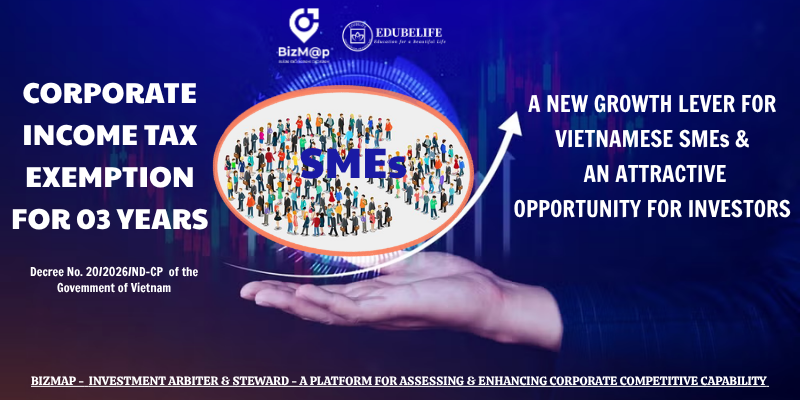
In Vietnam’s strategic journey to position the private sector as a new engine of economic growth, the Government has introduced a highly significant tax incentive: a 03-year Corporate Income Tax (CIT) exemption for newly registered small and medium-sized enterprises (SMEs).
This is not merely a support policy for start-ups. It is also a strong positive signal to domestic and international investors seeking high-potential opportunities in Vietnam.
Legal Basis
Pursuant to Clause 3, Article 7 of Decree No. 20/2026/ND-CP dated 15 January 2026, guiding Resolution No. 198/2025/QH15 of the National Assembly:
Newly established small and medium-sized enterprises shall be exempt from Corporate Income Tax for 03 years from the date of issuance of their first Enterprise Registration Certificate.
The exemption period is calculated continuously from the first year of establishment.
Which Enterprises Are Eligible?
Under Article 5 of Decree No. 80/2021/ND-CP, SMEs are classified into three categories: micro enterprises, small enterprises, and medium-sized enterprises.
Eligibility is determined based on a combination of the following criteria:
- Average number of employees participating in compulsory social insurance
- Annual revenue
- Total capital / total assets
- Business sector
This means an enterprise cannot determine its status based solely on internal assumptions or business labels. Proper legal and financial classification is essential.
Strategic Value for Enterprises
The first three years are often the most challenging period in a company’s lifecycle. Businesses typically face substantial pressure from:
- Building operational systems
- Recruiting and developing talent
- Entering the market
- Refining products and services
- Managing cash flow
A 03-year CIT exemption allows enterprises to retain more profits and reinvest capital into:
- Technology
- Marketing
- Human capital development
- Operational excellence
- Market expansion
In practical terms, this policy provides businesses with additional growth fuel at the most critical stage of development.
Strategic Value for Investors
For investors, tax incentives are far more than a reduction in tax liabilities. They create three tangible advantages:
- Enhanced Investment Returns
Higher retained earnings and stronger cash flow improve enterprise valuation and long-term returns.
- Lower Early-Stage Risk
Additional internal resources help businesses navigate the most fragile stage of growth.
- Stronger Market Appeal
The policy demonstrates Vietnam’s continued commitment to an open, business-friendly, and private-sector-driven economy.
EDUBELIFE & BIZMAP Perspective
Tax incentives create opportunities — but they are not a substitute for sound management. Enterprises can only maximize these benefits when they effectively govern the Three Corporate Lifelines:
Finance
Deploying tax savings strategically to accelerate sustainable growth.
Accounting
Maintaining transparent, reliable records that support eligibility and investor confidence.
Legal & Tax Compliance
Applying regulations correctly to avoid loss of incentives, penalties, or tax reassessments.
This is precisely why BIZMAP evaluates enterprises not only by market opportunity, but through a comprehensive competitiveness framework that supports both enterprises and investors.
Conclusion
The 03-year Corporate Income Tax exemption for newly registered SMEs marks an important policy advancement in Vietnam’s private sector development strategy.
- For enterprises: it is an opportunity to scale faster.
- For investors: it is a signal of a market with expanding growth potential.
When sound policy meets strong enterprises and smart capital, exceptional growth stories are created.
Các bài viết khác:
 BÀI 2: Khung Pháp Lý Tài Sản Số Việt Nam Hình Thành: Từ Vùng Xám Đến Thị Trường Có Trật Tự
 Làm sao điều hành, quản trị doanh nghiệp hiệu quả?
 Ms Hồng Trang – CEO of EDUBELIFE – Expert in finance and business for NEXUS’s Startups
 Ms. Hồng Trang – CEO EDUBELIFE, BIZMAP chia sẻ về Quản trị tài chính DN trên NSSC
 Trao đổi để có giải pháp tối ưu trong vận hành Doanh nghiệp ” với Team chuyên gia BIZMAP
